Car accidents happen in an instant, but determining who caused the crash can sometimes take weeks or even months. Whether you are pursuing compensation through an insurance claim or a personal injury lawsuit, proving fault is one of the most important steps in recovering damages after a California car accident.
California follows a fault-based insurance system, which means that the driver responsible for causing the accident is typically responsible for paying for the losses suffered by the victim. Building a strong claim for compensation requires a car accident victim to gather evidence of fault, such as photos and videos of the accident scene, witness statements, police reports, and more. Our Walnut Creek car accident lawyers will work with you to prove that the other driver was responsible for your losses and will fight to get you maximum compensation for your injuries.
The Appel Law Firm represents clients who have been injured in all types of accidents, including car accidents, boating accidents, bike accidents, and truck accidents. With decades of experience in California personal injury law, we are adept at proving fault so that our clients get the money that they deserve for their injuries. Reach out to our law offices today to schedule a free consultation with a Walnut Creek personal injury attorney.
Why Proving Fault Matters in Car Accident Cases
Proving fault is the foundation of nearly every California car accident claim. In personal injury cases, the injured party (plaintiff) generally has the burden of proving that the at-fault party (defendant) was responsible for the accident. Without evidence showing that the defendant caused a car accident, obtaining compensation for your losses will be difficult.
Fault affects several important aspects of a claim, including:
- Whether you recover damages (compensation)
- How much money you may receive
- Which insurance company is responsible for paying
- Whether your compensation may be reduced due to shared fault
- Whether litigation will be necessary
When fault is clearly established, insurance companies are often more willing to negotiate fair settlements. After all, if their insured caused the crash, they know that it will be difficult to win at trial. However, if liability is disputed, it can take much longer to resolve a claim. It may also result in a case going to trial.
California’s Fault and Negligence Laws
Most car accident claims are based on a theory of negligence or carelessness. Negligence occurs when someone fails to exercise reasonable care under the circumstances, causing injury to another person. For example, if someone backs out of a driveway without looking and crashes into someone, that would be considered negligent driving.
To establish negligence, a plaintiff must prove four elements:
- Duty of Care: All drivers have a legal duty to operate their vehicles safely and obey traffic laws.
- Breach: The defendant violated that duty by acting carelessly, such as by speeding, running red lights, driving under the influence, texting while driving, or following too closely.
- Causation: The defendant’s actions directly caused the accident.
- Damages: The victim suffered actual losses, such as injuries, medical bills, or property damage.
In most California car accident cases, the plaintiff has the burden of proving that the defendant was negligent. However, if the at-fault driver caused a crash while violating a law, the burden may shift to the defendant to prove that they were not negligent. This is known as negligence per se.
If a driver causes an accident while violating a law or statute, then there is a presumption that they were negligent. For example, if a driver hits your car while speeding and driving recklessly, then they are presumed to have acted negligently (and to be at fault for the accident). A defendant can still try to prove that they weren’t negligent, but the burden will be on them to do so.
Negligence per se can be important in a car accident case because it means that a car accident victim likely won’t have to prove fault. Our Walnut Creek car accident attorneys can help you to determine if this legal theory may be used in your case. If not, we will investigate your case and gather evidence to prove that the other driver caused your accident.
California’s Pure Comparative Negligence Rule
California follows what is known as a pure comparative negligence system. Under this rule, an injured person can still recover compensation even if they were partially responsible for the accident. However, their recovery will be reduced by their percentage of fault.
Unlike most states, California’s comparative negligence rule is “pure.” This means that a car accident victim can still pursue a claim even if they were more than 50% at fault. While your recovery will be reduced substantially if you bore the majority of fault for an accident, it may still be possible to pursue a claim.
The way that comparative negligence works is simple. Consider a case where a victim suffered $100,000 in losses in a car accident. A jury finds that they were 20% at fault for the crash, so their total recovery would be $80,000 ($100,000 minus 20%).
Comparative negligence is important in car accident cases because insurance companies frequently attempt to shift blame onto accident victims. An insurance adjuster may claim that:
- The victim was speeding
- The victim was distracted
- The victim changed lanes improperly
- The victim failed to brake in time
Because compensation is reduced according to fault percentages, insurers have a financial incentive to increase the amount of blame assigned to car accident victims. This makes the collection of evidence in a car accident claim even more important.
Step-By-Step Guide to Proving Negligence in a California Car Accident Case
Building a successful claim requires gathering evidence that demonstrates exactly how the collision occurred. The following steps can be useful:
- Call Law Enforcement: After an accident, contacting law enforcement is often one of the most important first steps. Responding officers typically:
- Investigate the scene
- Interview drivers and witnesses
- Document vehicle positions
- Note road conditions
- Make a record of visible injuries
- Identify possible traffic violations
The resulting police report can become valuable evidence during the claims process. Although police reports are not always conclusive, insurance companies often consider them when evaluating liability.
- Seek Immediate Medical Attention: Prompt medical treatment helps establish a connection between the accident and your injuries. Delays in treatment can create opportunities for insurers to argue that:
- Injuries were pre-existing
- Injuries occurred elsewhere
- Injuries are less serious than claimed
Medical records frequently become key evidence in proving both damages and causation.
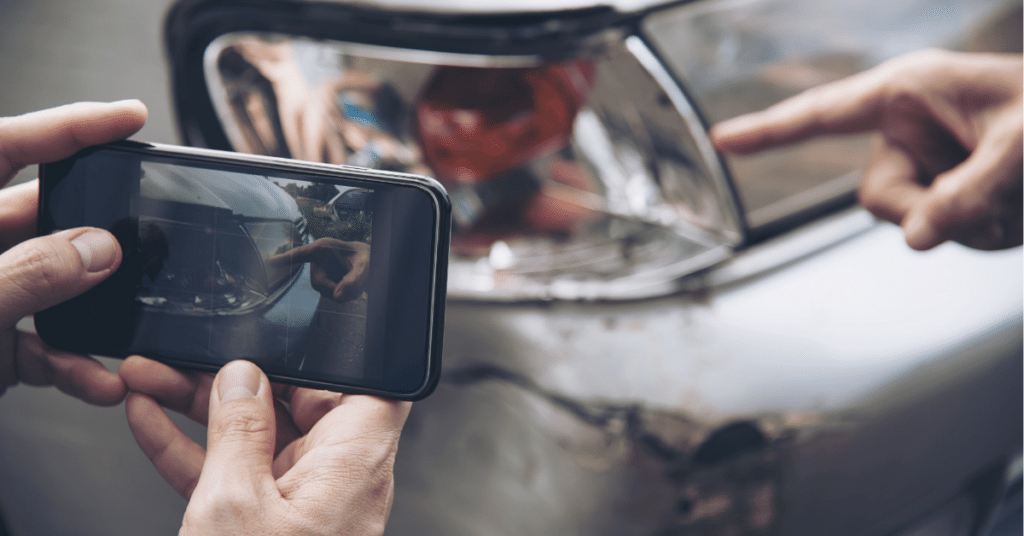
- Document the Accident Scene: If it is safe to do so, gather as much evidence as possible before leaving the scene. Try to take photos and videos of:
- Vehicle damage
- Skid marks
- Debris fields
- Traffic signals
- Road signs
- Weather conditions
- Road hazards
- Visible injuries
Photos often provide powerful visual evidence that helps to explain how a collision occurred.
- Collect Witness Information: Independent witnesses can play a crucial role in disputed liability cases. Witnesses may provide unbiased accounts regarding:
- Vehicle speeds
- Traffic signal status
- Lane positions
- Driver behavior before impact
Obtaining names and contact information immediately after the accident can preserve important testimony.
- Preserve Electronic Evidence: Modern vehicles and technology frequently generate valuable evidence. Potential sources include:
- Dash cam footage
- Surveillance cameras
- Traffic cameras
- Vehicle event data recorders
- GPS records
- Cell phone records
Electronic evidence can sometimes provide definitive proof regarding fault.
- Notify Insurance Companies: Promptly reporting the accident helps to preserve your claim. However, it is important to exercise caution when speaking with insurers. Avoid:
- Admitting fault
- Guessing about the accident details
- Speculating about injuries
Statements made early in the process may later be used against you.
- Consult an Attorney: The earlier that you secure legal representation, the easier it may be to preserve evidence and investigate liability. A Walnut Creek car accident lawyer can immediately begin gathering documentation before critical evidence disappears. They can also work with experts, such as accident reconstruction experts, to establish fault.
Protecting Your Rights After a California Car Accident
Proving fault is one of the most important aspects of any California car accident claim. Police reports, witness statements, dash cam footage, photographs, medical records, and expert testimony all play important roles in establishing fault. The stronger the evidence, the stronger your claim will be.
If you have been injured in a California car accident, the Appel Law Firm is here to help. Our team can evaluate your case, investigate the cause of the accident, and help you pursue the compensation that you deserve. To learn more or to schedule an appointment with a Walnut Creek car accident lawyer, give us a call at (925) 938-2000 or fill out our online contact form.